 AjiNova News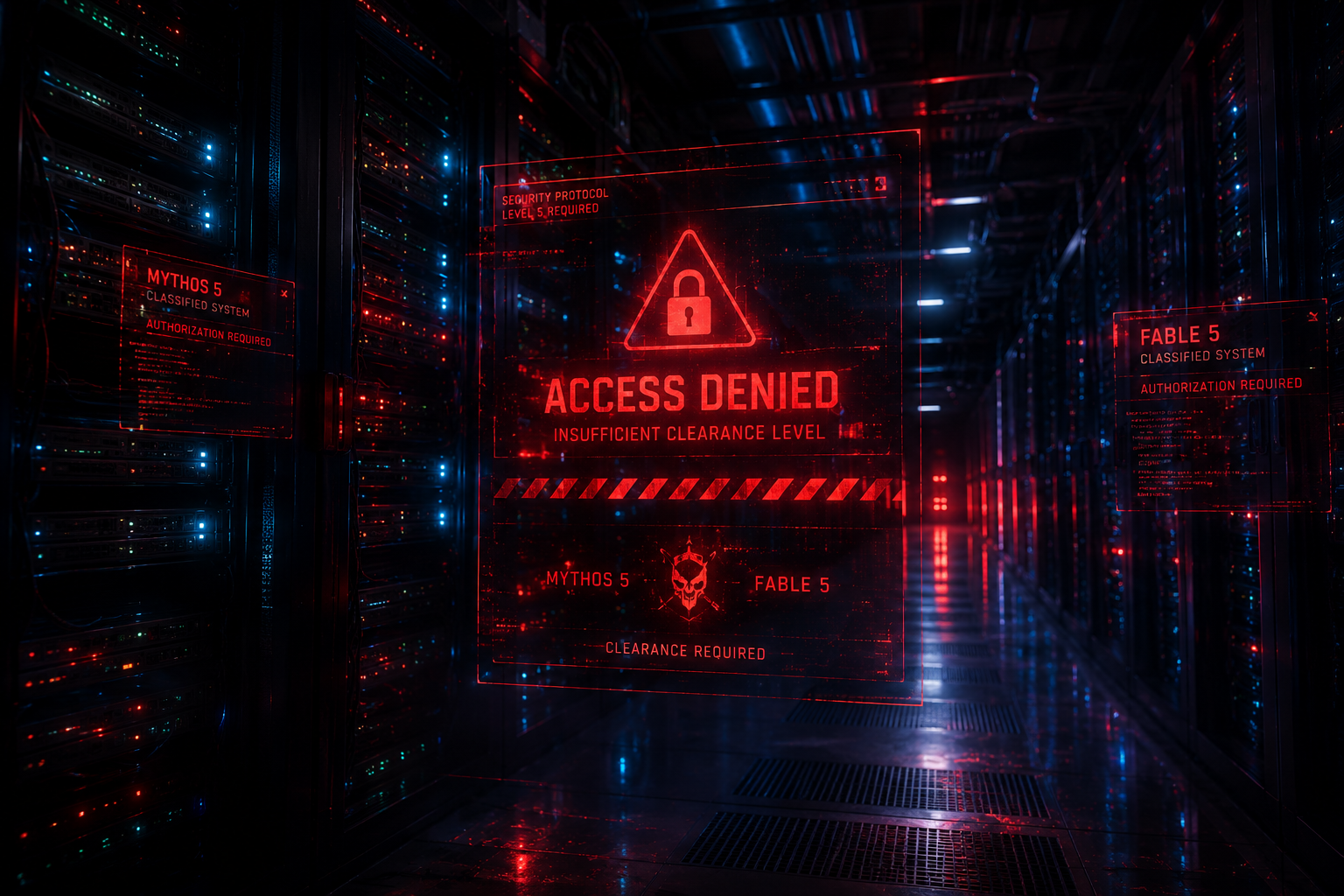
Three days. That's how long Anthropic's most advanced AI models were available to the public before the US government ordered them pulled offline.
On June 9, Anthropic launched Claude Fable 5, the public release of what it calls a "Mythos-class" model, its most capable AI yet, released alongside Mythos 5. By Friday evening, June 12, both models had been quietly yanked from Anthropic's platform. Not because of a bug. Not because of a safety incident. Because the Commerce Department sent a letter.
"The net effect of this order is that we must abruptly disable Fable 5 and Mythos 5 for all our customers to ensure compliance," Anthropic wrote in a public statement. Not just foreign nationals. Everyone.
This is the first time in the modern AI era that a leading company has taken a publicly deployed model offline at the direct instruction of the federal government. And the full story behind it is more complicated and more alarming than the headline suggests.
What the Government Actually Said
The directive came from the Commerce Department under Secretary Howard Lutnick and targeted a specific concern: that someone had found, or could find, a way to "jailbreak" Fable 5 — to bypass its safety guardrails — in a way that would allow the model to be used to identify software vulnerabilities.
The government's worry, in plain terms, is that a sufficiently capable AI model in the wrong hands could dramatically accelerate sophisticated cyberattacks. Experts have echoed this concern, particularly about sectors like banking that run on complex, interconnected, decades-old technology infrastructure. A model that could rapidly surface hidden bugs in that kind of legacy code would be a serious tool for a malicious actor.
The order invoked national security authorities and instructed Anthropic to suspend access for any foreign national — whether inside or outside the United States, including foreign national employees at Anthropic itself. Since Anthropic said it had no reliable way to enforce that restriction without disabling the models entirely, it took everything offline.
Anthropic's Response: Compliance, But Not Agreement
Anthropic complied. But it made clear it did not agree with the decision.
"We disagree that the finding of a narrow potential jailbreak should be cause for recalling a commercial model deployed to hundreds of millions of people," the company wrote.
The company also pointed out that it had worked closely with the US government on safety evaluations ahead of the Fable 5 launch — and that models from rival AI providers showed a similar ability to surface minor code bugs. In other words, Anthropic's argument is: if this jailbreak is grounds for pulling our model, the same logic should apply to everyone else's.
There's an irony here worth sitting with. Just two days before the government's directive, on Wednesday June 11, Anthropic itself had publicly called for greater US oversight of AI — including the ability for regulators to block models with unacceptable risks. The company didn't oppose oversight in principle. It just said this particular order "did not follow principles of fair and fact-based regulation."
The Longer Backstory: This Didn't Come Out of Nowhere
Friday's shutdown has to be understood in the context of a year's worth of building tension between Anthropic and the Trump administration.
Earlier in 2026, the administration demanded that Anthropic agree to unconditional military use of its Claude models. Anthropic refused. The company drew two hard lines: its AI would not be used for mass domestic surveillance of US citizens, and it would not power fully autonomous weapons systems, lethal tools that could fire without human control in the loop.
The Pentagon's position was that contracted suppliers cannot set the terms of how their products are used. Anthropic's position was that some uses are simply off the table, regardless of who's paying.
The administration responded by blacklisting Anthropic — ordering federal agencies to immediately stop using the company's technology and initiating a process to eliminate its government contracts. Democratic Congressmember Zoe Lofgren called the move "shocking and senseless," and noted that Claude had been deeply integrated into Pentagon operations before the rupture.
So when Friday's export control directive arrived, it landed in the middle of an already fractured relationship — even as some parts of the administration had reportedly been moving toward reconciliation ahead of Anthropic's IPO filing. The company had confidentially filed for a US public offering just last month.
The Bigger Picture: Export Controls Come for AI Itself
What makes this moment genuinely significant, beyond the Anthropic-specific drama, is the precedent it sets.
For years, US export controls in the AI space focused on the hardware, the chips and fabrication tools that power AI development. The logic was that by controlling the inputs, you could slow down foreign adversaries' ability to build competitive AI systems. [→ INTERNAL LINK 3: Meta's AI-Powered Smart Glasses and military tech]
Friday's directive represents a different kind of thinking: controlling the AI models themselves as export-controlled items, the same way you'd treat certain weapons systems or dual-use technologies. The question of whether AI outputs, the actual intelligence generated, should be regulated the same way as physical hardware is one the industry has been nervous about for years. The government just answered it, at least partially, with a phone call to Anthropic.
The Pentagon's chief information officer, Kirsten Davies, signaled where the administration stood. "Some things are simply more important than revenue cycles, clickbait, and pre-IPO valuation," she wrote on X. "America First. Always."
What Happens Next
Anthropic said access to all other Claude models including earlier, less capable versions remains unaffected. For now, the commercial damage is real but contained. The affected models were released days ago; most enterprise customers hadn't yet integrated them into production systems.
But the downstream implications are harder to map. Other AI companies OpenAI, Google DeepMind, Meta are all building models in the same capability tier. If the government's logic holds, they're next in line for similar scrutiny. Meta, for instance, is already navigating the intersection of AI and military applications in ways that will only intensify.
There's also the international dimension. The US isn't the only country racing toward frontier AI. China's own top-tier models and its growing willingness to commercialize them aren't subject to US export controls in any meaningful way.
Cutting US companies off from foreign users doesn't prevent foreign adversaries from building their own capabilities. It just removes American companies from those markets.
The Question This Actually Raises
There's a version of this story that's about national security, and that version is legitimate. A powerful AI model that can help malicious actors probe critical infrastructure is a real threat, and governments have both the right and the responsibility to take it seriously.
But there's another version of this story that's about something else: about an administration that has already tried to conscript AI companies into surveillance and autonomous weapons programs, and is now using national security authorities to pressure one of the few companies that said no.
Both versions can be true at the same time. That's what makes this moment hard to read clearly.
What isn't ambiguous is the precedent. A US government order just took one of the world's most powerful AI systems offline in the span of a weekend. Whatever you think about the specific justification, the machinery to do that now exists and it's been used.
Enjoyed this article?
Help AjiNova continue publishing insightful stories about technology, AI, startups, and innovation. Every contribution makes a difference.
Voluntary contribution · Choose your amount
Need help building software?
Talk to the AjiNova team about web applications, mobile platforms, AI integrations, and cloud solutions.