 AjiNova News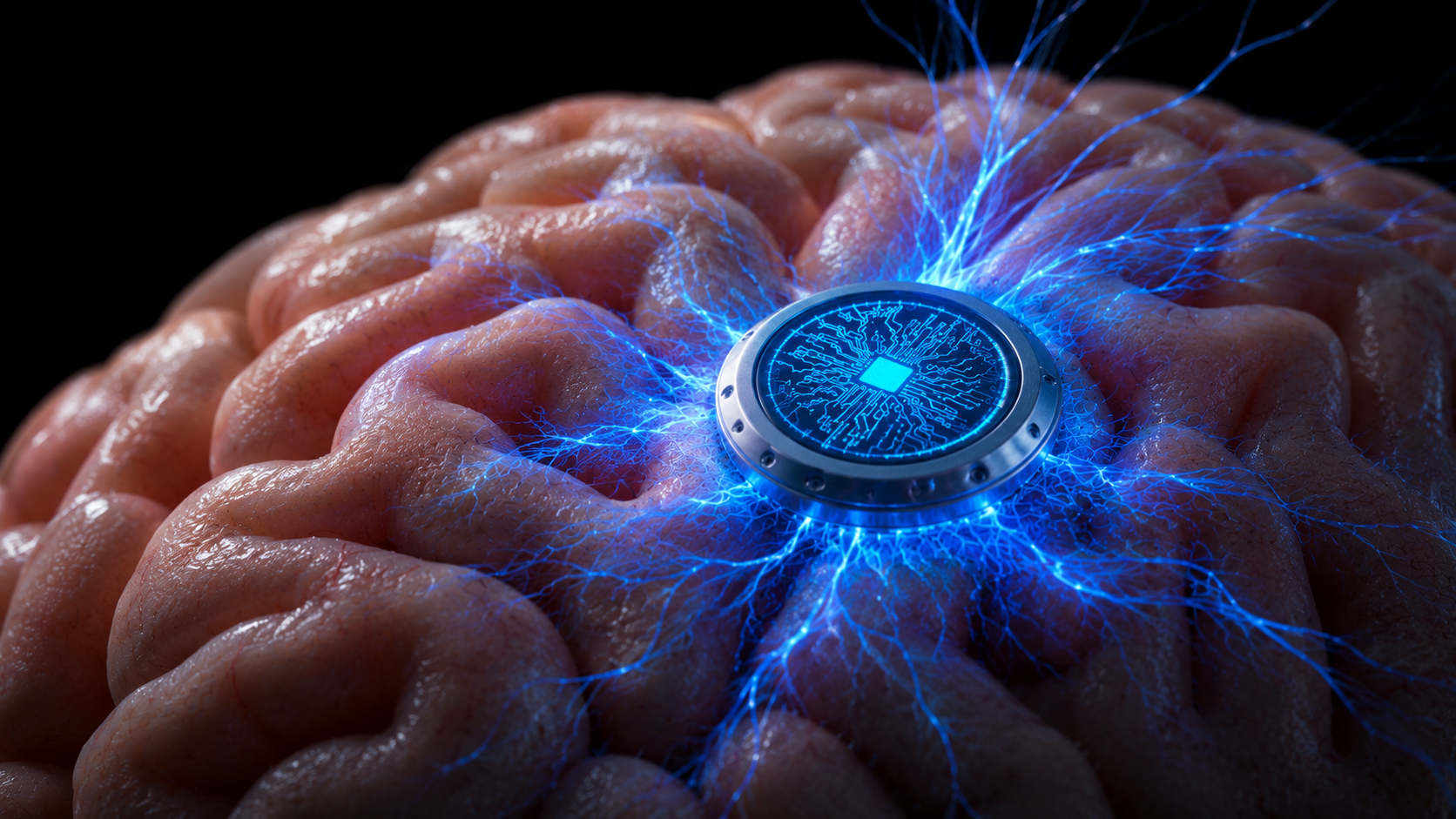
China Just Beat Neuralink to the World's First Commercially Approved Brain Chip
There's a moment Dong Hui keeps coming back to. He was sitting in the courtyard of his home in Henan province last October, nearly six years after a car accident had robbed him of movement from the neck down. He picked up a pen. And then, slowly, he wrote his name.
He was so overwhelmed he missed a stroke.
"I couldn't believe I was able to write again, I was so excited I even missed a stroke in my name." : the 39-year-old said in a video call with MIT Technology Review.
What made that moment possible was a small device implanted in his skull, a brain-computer interface called NEO, developed by Shanghai-based Neuracle Technology in collaboration with researchers at Tsinghua University. And in March 2026, that same device became the first invasive brain chip in the world to receive commercial regulatory approval, cleared by China's National Medical Products Administration (NMPA) for use in patients paralyzed by spinal cord injuries.
It's a genuinely historic milestone, even if it has been somewhat drowned out by the noise of the ongoing AI race.
What Is NEO, Exactly?
NEO is roughly the size of a coin. During an implantation procedure lasting just over 90 minutes, surgeons place eight sensors against the dura mater — the tough outer membrane that wraps around the brain — without penetrating brain tissue itself. A small processor sits on the skull beneath the scalp, wirelessly translating the patient's neural signals into commands for external devices.
In Dong's case, that external device is a soft robotic glove. He trains with it for two and a half hours a day. By the ninth day, he managed to grab a ball without the glove entirely. Today he's working toward buttoning his shirt, eating on his own, and reducing the daily burden on his aging parents.
The NMPA has approved NEO for adults between 18 and 60 years old with full-limb paralysis caused by cervical spinal cord injuries who still retain some residual arm function. Since October 2023, Neuracle conducted 36 clinical trials using the device, 32 of them completed in a concentrated push throughout 2025.
The Design Choice That Made the Difference
One reason NEO reached commercial approval before its competitors comes down to a deliberate engineering trade-off: it sits on the brain's protective membrane rather than piercing into the cortex itself.
This makes it "relatively less invasive" compared to devices like Neuralink's N1 chip, according to Avinash Singh, a BCI researcher at the University of Technology Sydney. Neuralink's approach involves tiny flexible threads inserted directly into brain tissue to capture high-resolution neural signals giving it potentially superior data quality, but also a higher surgical risk profile and a more complex regulatory path.
Neuracle chose a different bet. By accepting somewhat lower signal fidelity in exchange for a safer, simpler procedure, they built a device that regulators could more readily approve and that hospitals could more readily deploy.
It's not that one approach is better than the other in any absolute sense. They're optimizing for different things. Neuralink wants granular precision. NEO wants scale.
China vs. Neuralink — But Not Quite a Race
The framing that has dominated coverage, -China beats Elon Musk- is catchy, and not inaccurate. But it flattens a more complicated picture.
Neuralink remains arguably more technically ambitious. Its N1 chip uses over 1,000 electrodes implanted directly in the cortex, enabling the kind of fine-grained neural control that has let paralyzed patients play video games, move computer cursors, and potentially communicate. As of early 2026, the company had 21 participants enrolled in its human trials and was planning to scale toward automated surgery this year.
The FDA originally rejected Neuralink's application to begin human trials back in 2022 over safety concerns. Approval eventually came in 2023, and trials have proceeded cautiously since then cautiously enough that NEO slipped through to commercial clearance first.
There's also a geopolitical subplot worth noting. Despite the broader US-China technology tensions, American BCI company Axoft - based in Cambridge, Massachusetts has been quietly running trials of its own chip in China in collaboration with local partners and a Shanghai hospital. The two countries' BCI industries are, in some ways, less adversarial than their governments.
What Happens Next for Patients
With commercial approval secured, Neuracle is now scaling up production to meet demand. Insurance coverage for NEO has reportedly been put in place within China's public health system, meaning the device should become accessible to patients across the country in the months ahead not just in elite research hospitals.
A second Chinese BCI, called Beinao-1, developed by the Chinese Institute for Brain Research and its affiliated startup NeuCyber NeuroTech, also uses a dura mater placement approach and targets movement and speech difficulties from spinal cord injuries or ALS. Researchers estimate it could receive approval as early as 2028.
That pipeline matters. China has an estimated 500,000 new spinal cord injury cases per year, many involving younger patients injured in road accidents or workplace incidents. The scale of unmet need is enormous. And Beijing which has explicitly identified BCI technology as a strategic priority is pushing hard to move from laboratory breakthroughs to clinical deployment at a national scale.
Why This Is a Bigger Deal Than It Sounds
Brain-computer interfaces have existed as research tools for decades. The BrainGate consortium was demonstrating rudimentary neural control of computer cursors in the early 2000s. What's new about NEO isn't the underlying concept, it's the regulatory and commercial leap.
For the first time, a device that involves surgically implanting hardware into a human skull has cleared a national regulator not just for trials, but for routine clinical use. It can now be prescribed, sold, and implanted at standard hospitals. That's the threshold that matters. Everything before it was a proof of concept. This is the beginning of a market.
The question that follows is no longer can this work, it's who gets access, at what cost, under what conditions, and with what long-term support. Those are harder questions, and they don't get resolved at the regulatory approval stage. But they're the right ones to be asking now.
For Dong Hui, sitting in his courtyard in Henan and writing his name again, those questions are secondary to something simpler: the possibility that next year, he might be able to put on his own clothes.
That's what this technology is actually for.
Enjoyed this article?
Help AjiNova continue publishing insightful stories about technology, AI, startups, and innovation. Every contribution makes a difference.
Voluntary contribution · Choose your amount
Need help building software?
Talk to the AjiNova team about web applications, mobile platforms, AI integrations, and cloud solutions.