 AjiNova News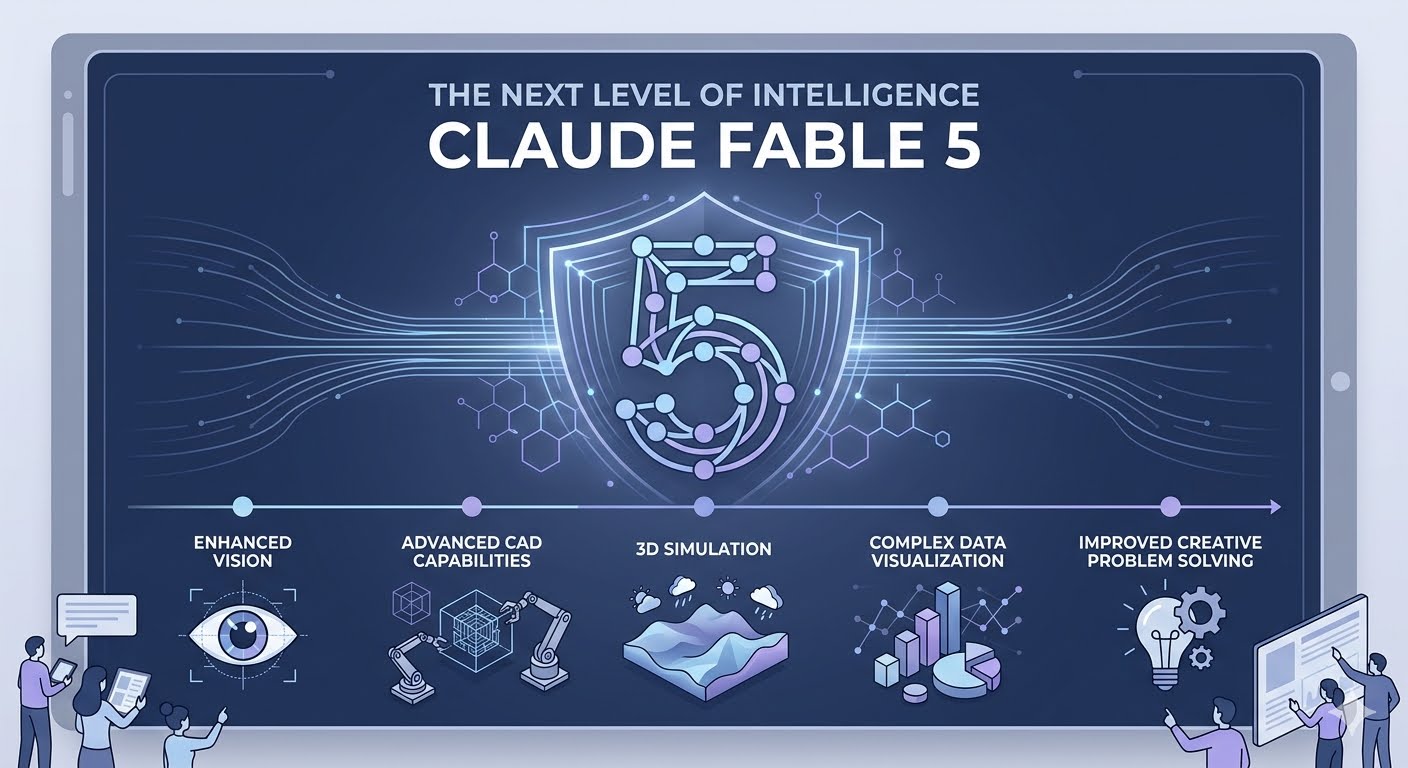
The Wait Is Over
For the past two months, the most capable AI model Anthropic had ever built was locked behind a restricted programme called Project Glasswing, available only to a handful of partners — AWS, Microsoft, Apple, and CrowdStrike among them. The model was called Claude Mythos Preview, and what little leaked about it was enough to make the AI industry pay close attention.
Today, June 9, 2026, Anthropic made its move. Claude Fable 5 is now live — the public version of that Mythos-class model — and with it, Anthropic has effectively created a new tier of AI capability above the existing Opus family.
This is not a minor version bump. This is a new class of model.
What Fable 5 Actually Is
Claude Fable 5 is built on the same underlying architecture as Claude Mythos, with targeted safeguards applied for public release. Anthropic says Fable 5 shows exceptional performance across three areas in particular: software engineering, knowledge work, and vision. Critically, Anthropic notes that the model's advantage over previous Claude versions grows on longer, more complex tasks — the kind of multi-step, multi-hour work that distinguishes genuine capability from benchmark performance.
In testing, 95 percent of Fable sessions ran entirely on Fable responses without any fallback. The remaining 5 percent hit one of the model's high-risk domain restrictions — covering cybersecurity exploits, biology, chemistry, and model distillation — at which point the system automatically falls back to Claude Opus 4.8. It is a reasonable tradeoff. You get a dramatically more capable model for the vast majority of work, with a safety net that activates in the small fraction of sessions where the risk calculus changes.
Alongside Fable 5, Anthropic has also released a Claude Mythos 5 configuration — the same underlying model with some of those safeguards lifted — but access to Mythos 5 remains tightly controlled and is currently limited to Project Glasswing partners and selected researchers in biology.
The Context: Why Mythos Existed at All
When Anthropic introduced Claude Mythos Preview in April 2026, the reason for the restricted rollout was straightforward: the model had demonstrated an exceptional ability to autonomously discover and chain zero-day exploits across major operating systems and browsers. That is not the kind of capability you hand to the open internet without a plan.
The Blue Team at Anthropic, along with CrowdStrike and other security partners, spent two months stress-testing what Fable looks like with guardrails. The result is a model that retains strong reasoning, coding, and defensive security capabilities — the things that make it genuinely useful for engineers — while blocking the narrow set of prompts that would meaningfully uplift someone trying to cause harm.
Whether those safeguards will hold under adversarial pressure is the question the security community will spend the next few weeks answering. The initial signs are that Anthropic has been more careful here than most labs would be, but careful does not mean invincible.
Pricing and Access
Fable 5 is priced at $10 per million input tokens and $50 per million output tokens. That is double the cost of Claude Opus 4.8, which has been the performance ceiling until today. The original Mythos pricing shared in April was reportedly five times higher than Opus, so the public version represents a significant reduction — presumably driven by inference optimisations developed during the Glasswing period.
For Pro, Max, Team, and Enterprise plan subscribers, Fable 5 is included at no extra cost through June 22, 2026. After June 23, usage credits will be required until capacity expands. Anthropic has been explicit that this is a capacity constraint, not a pricing change — the model is computationally expensive to run at scale.
One notable policy change accompanies the launch: Anthropic has imposed a mandatory 30-day data retention requirement on all Fable traffic, including enterprise agreements that previously operated under zero-retention terms. Anthropic frames this as a safety monitoring requirement. Enterprise customers who built their workflows around zero-retention guarantees will want to review what this means for their data handling obligations before moving workloads to Fable.
What This Means for Developers
If you are building with the Anthropic API, the practical implication is that you now have access to a model that Anthropic itself describes as performing in a different category from Opus on extended tasks. For AjiNova's engineering work — complex codebases, multi-step reasoning, long-context document analysis — the jump from Opus 4.8 to Fable 5 is likely to be meaningful in the same way that early Claude 3 Opus was meaningful over Claude 2.
The API model string is not yet confirmed in official documentation as of publication, but based on Anthropic's naming conventions it is expected to follow the pattern used for Opus models. Check the Anthropic docs for the current string before deploying.
The 30-day data retention policy deserves a second look if you are handling client data. Review your privacy policy and client agreements before routing sensitive workloads through Fable. For most development and internal tooling use cases it will not be an issue, but it is worth knowing before your first production deployment.
The Bigger Picture
Anthropic has been preparing for an IPO, with reports of a confidential S-1 filing and a valuation approaching one trillion dollars. Claude Fable 5 is the product that validates that trajectory. It is not just a new model — it is proof that Anthropic can take its most capable and most restricted research and bring it to market in a form that is commercially viable and responsible at the same time.
Whether that balance holds as more developers push against its edges is the story to watch over the next few months.
For now, the ceiling just moved.
Enjoyed this article?
Help AjiNova continue publishing insightful stories about technology, AI, startups, and innovation. Every contribution makes a difference.
Voluntary contribution · Choose your amount
Need help building software?
Talk to the AjiNova team about web applications, mobile platforms, AI integrations, and cloud solutions.