 AjiNova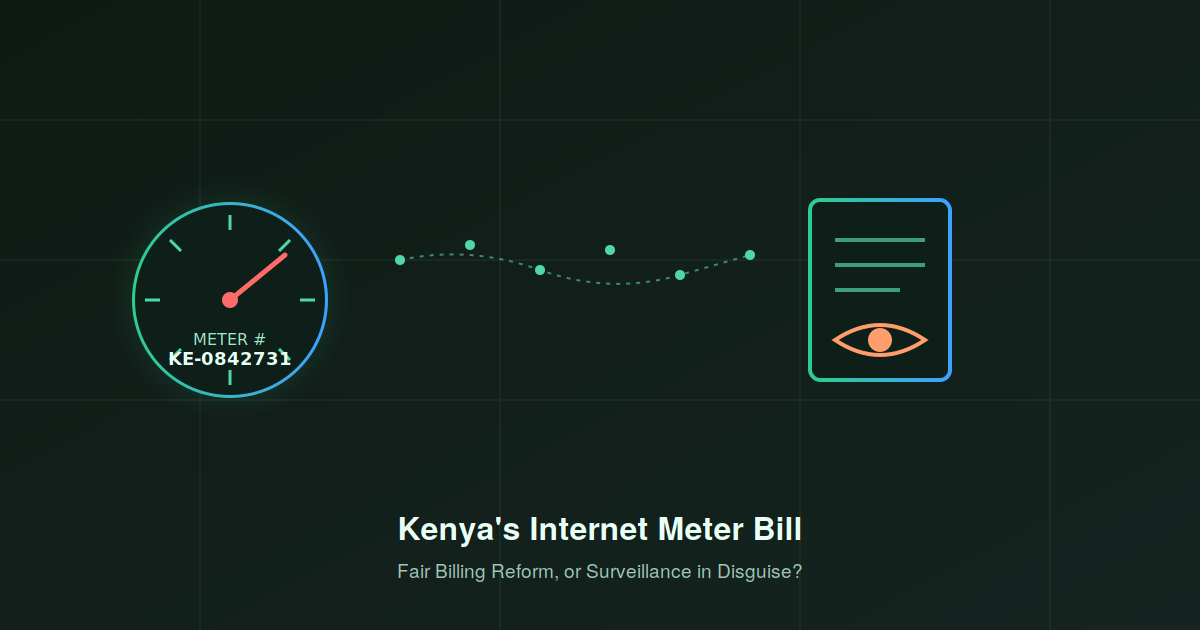
Kenya's New Internet Bill Wants to Give You a "Meter Number." Critics Say It's Surveillance in Disguise
A bill quietly working its way through Kenya's Parliament could change how every internet user in the country is tracked, billed, and potentially monitored — and it's drawing sharp warnings from rights groups who say the fine print looks less like a billing reform and more like a surveillance system.
What the Bill Actually Says
The Kenya Information and Communications (Amendment) Bill, 2025, was introduced by Aldai MP Maryanne Kitany. On its face, it's about fixing what she describes as unfair internet billing — the same argument used for metered electricity and water. Instead of flat monthly fees regardless of usage, Kenyans would pay based on how much data they actually consume.
To make that possible, the bill would require every internet service provider — think Safaricom, Starlink, Zuku, Jamii Telkom, and Faiba — to build a "Meter Billing System" that does four things for each customer:
- Assigns a unique, identifiable meter number to every subscriber
- Continuously monitors that subscriber's data usage
- Converts the raw usage data into detailed, readable reports
- Generates invoices based strictly on actual consumption, so customers can verify their own bills
On top of that, ISPs would be legally required to report to the Communications Authority of Kenya (CA) at least once every financial year, submitting information on their billing systems — including the meter numbers themselves.
The bill also redefines "Telecommunication Operator" under the existing Kenya Information and Communications Act to explicitly cover ISPs, meaning any provider that wants to keep operating would eventually fall under this framework once current licenses expire.
Why This Sounds Reasonable on Paper
Metered billing isn't a radical idea. Electricity and water are billed this way, and proponents argue it could actually lower costs for light users — students, casual browsers, and people who barely stream video — while heavier users pay proportionally more. Kitany has framed the bill as a consumer protection measure tied to Article 46 of Kenya's Constitution, which addresses the economic interests of consumers. It's one of several tech-related bills moving through Kenya's legislature this year — alongside a proposed AI law that's drawing its own share of scrutiny.
Where the Alarm Bells Start Ringing
The concern isn't the billing model — it's the meter number itself, and what it makes technically possible.
Right now, most home and mobile internet connections use IP addresses that rotate periodically, making it harder to build a permanent, continuous profile of any one person's online activity. A unique meter number tied permanently to an individual subscriber removes that natural friction. Once that identifier exists and is linked to detailed usage logs, it becomes possible to build a long-term behavioral trail for that person — not just how much data they used, but potentially patterns of when, and how often.
ICJ Kenya — the International Commission of Jurists' Kenyan Section — has been the most vocal critic, warning that the bill is a Trojan horse for mass surveillance and predicting that surveillance infrastructure, once built, tends to expand rather than get dismantled. The organization has also pointed out that the bill offers no clarity on how this sensitive data would be stored, protected, or restricted from unauthorized access.
They're not the only ones raising red flags. Amnesty International Kenya's technology and human rights team has argued that assigning a unique, identifiable meter number to every person effectively creates a data trail by design — not a side effect. Legal analysts have separately pointed out that the bill could conflict with Article 31 of Kenya's Constitution, which protects the right to privacy, as well as protections already established under the Data Protection Act, 2019.
The Context Makes It More Sensitive
Timing matters here. Kenya has a documented history of internet disruptions and surveillance during politically tense periods — including shutdowns around the 2017 election and monitoring during the 2024 Gen Z-led protests. ISPs have also faced allegations of cooperating with security agencies during a wave of enforced disappearances of government critics, which is now the subject of a separate public interest legal petition involving ICJ Kenya, the Law Society of Kenya, Katiba Institute, and telecom companies as respondents.
Against that backdrop, critics argue that handing the state a built-in mechanism to track every citizen's internet identity and usage patterns is a much bigger ask than it appears — regardless of the billing-fairness justification attached to it.
What Happens Next
The bill isn't law yet. It's currently sitting with the National Assembly's Departmental Committee on Communication, Information and Innovation, which is required to collect input from stakeholders — including ISPs, consumer advocacy groups, and civil society organizations like ICJ Kenya — before compiling a report back to Parliament.
That means the public comment window is where this fight will actually play out. Advocacy groups are pushing for the bill to be substantially amended or rejected outright unless it comes with clear limits on data retention, strict rules on who can access the information, and a formal human rights impact assessment.
The Bottom Line
Nobody is arguing against fairer internet billing. The dispute is over whether a permanent, government-visible identifier tied to every Kenyan's internet activity is a necessary tool for that goal — or a surveillance capability wearing a billing-reform costume. As the bill moves through committee review, that's the question Kenyans and their representatives will need to answer.
Related: Kenya Wants to Be Africa's AI Capital. Its Own AI Bill Will Decide If That's Possible.
Need help building software?
Talk to the AjiNova team about web applications, mobile platforms, AI integrations, and cloud solutions.