 AjiNova News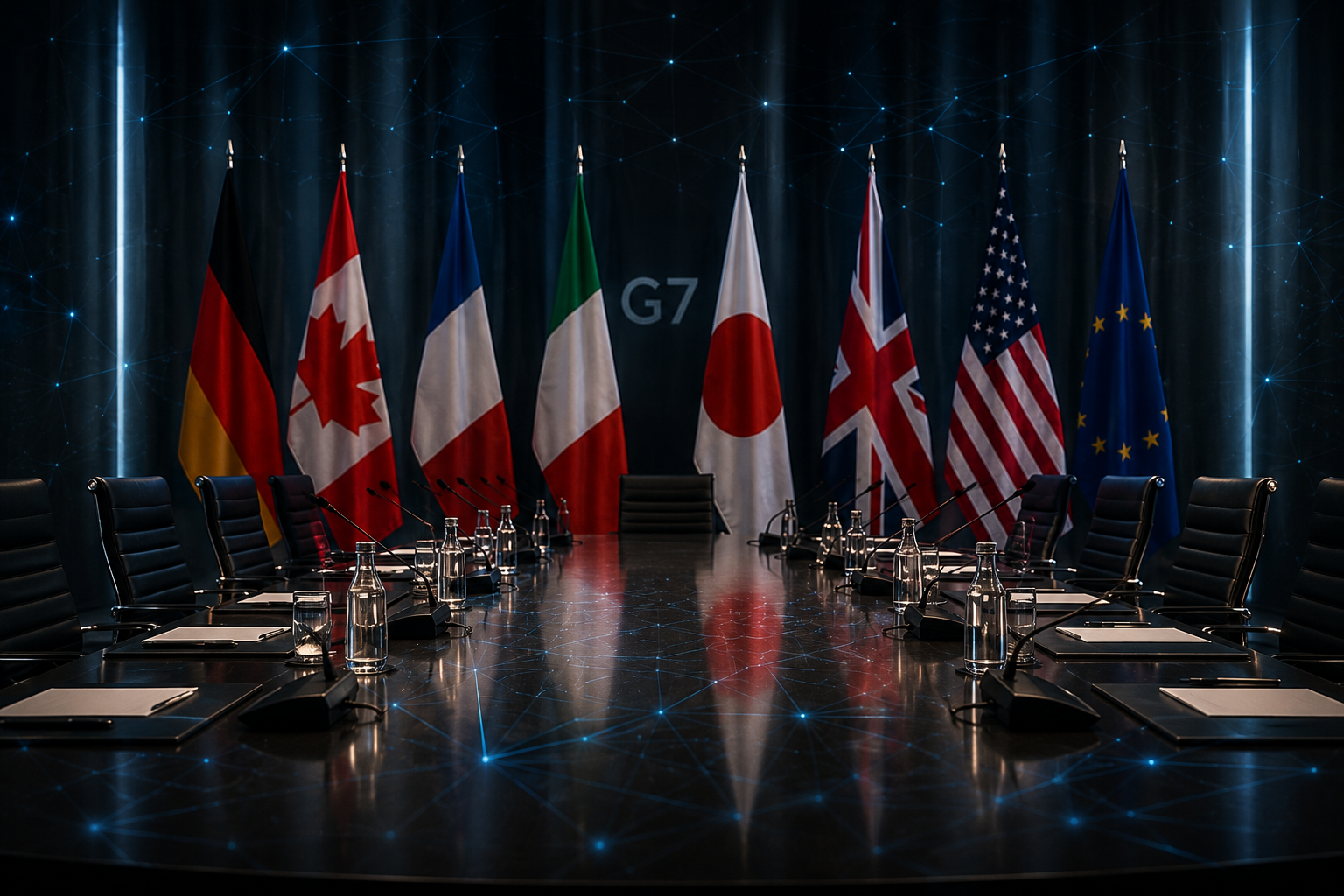
There's a photograph from Wednesday's G7 summit in Évian-les-Bains that says more than most of the official statements that came out of it. Sam Altman, CEO of OpenAI, seated beside President Trump at a working lunch table. Around them, the heads of state of the world's seven wealthiest democracies. It is, by any reasonable historical comparison, an extraordinary image.
On June 17, 2026, the CEOs of OpenAI, Anthropic, and Google DeepMind — Sam Altman, Dario Amodei, and Demis Hassabis — joined G7 leaders for what the French presidency billed as the first-ever working lunch on AI governance at a leaders' summit. Roughly a dozen other AI lab chiefs joined too, including representatives from Mistral, Cohere, Sarvam AI, and Black Forest Labs.
It is the first time all three leaders of the dominant US frontier AI labs have appeared together at a G7 summit. The timing was not coincidental, and neither was the tension underneath the polite diplomatic framing.
The Crisis That Set the Stage
Because Anthropic had no reliable way to restrict access by nationality alone, it took the models offline entirely. As of the G7 summit, six days later, both models remained offline globally.
That decision landed in Europe like confirmation of a fear policymakers had been quietly nursing for years: that the United States could, unilaterally and with no advance warning, flip a switch on AI infrastructure that allied governments and companies had come to depend on. Emerson Brooking, senior fellow at the Atlantic Council, put it directly: multiple G7 nations had assumed sovereign AI investment would happen alongside continued access to US frontier models, not as a hedge against losing that access entirely.
President Macron reportedly warned, in characteristically blunt terms, that nobody will buy US AI if they fear it can be switched off at any moment. That sentence may end up being the most consequential line to come out of Évian.
What Actually Happened in the Room
At the closed-door lunch, Anthropic's Amodei and Google DeepMind's Hassabis both pushed for a US-led coalition to set global rules and standards around AI — specifically naming structured access to frontier models and chip trade agreements that would exclude China as priority areas. Amodei also called for international cooperation on AI risk in cyber, bioterrorism, and intelligence domains.
Altman took a different tack, calling for an international forum that would establish globally accepted standards for AI testing and provide independent analysis of capabilities and risk — something closer to an IAEA-style body for AI than a coalition of allied governments.
The session also covered child safety online, an area where G7 leaders ultimately secured what's being described as a historic joint agreement — voluntary commitments from the assembled AI labs to develop tools protecting minors. It's worth being precise about what that agreement actually is: a voluntary, non-binding pledge, not law. Whether it becomes a meaningful global baseline or a forgotten press release depends entirely on follow-through that has, historically, been inconsistent in this industry.
The Part That Should Make You Pause
Step back from the diplomatic choreography for a moment and look at the structural reality the summit revealed.
Three private companies — OpenAI, Anthropic, and Google — now control the most capable AI systems on the planet. Every government in that room runs meaningful parts of its critical infrastructure, in some capacity, on technology built by those three companies. No parliament anywhere voted these systems into existence. No international treaty currently governs how they're built, deployed, or restricted. And yet their CEOs sat at Évian not as vendors summoned to answer questions, but functionally as peers to heads of state, shaping the agenda as much as responding to it.
That's not a conspiracy. It's just where unprecedented technological concentration naturally leads. When a handful of companies hold capabilities that governments themselves don't fully understand or control, those companies inevitably end up at the table where decisions get made — because nobody else in the room can speak credibly to what's actually possible.
Why This Matters Beyond Policy Circles
For anyone building with AI, using AI tools daily, or simply trying to understand where this technology is heading, Évian is a useful marker. It's the moment the question of who controls frontier AI stopped being a specialist policy debate and became visible, photographed, front-page geopolitics.
The practical stakes are direct rather than abstract. If access to frontier AI increasingly flows through political alliances rather than open commercial markets — which is precisely the direction signalled by both the Fable 5 export controls and the "trusted partners" framework reportedly discussed at the summit — then which side of that alliance structure a country, a company, or a developer sits on becomes a determining factor in what technology they can actually use.
That has real implications well beyond Washington, Brussels, and Évian. Developing economies, including much of Africa, are watching this unfold from outside the rooms where the rules are being written — which makes domestic AI strategy and regional digital sovereignty conversations, the kind Kenya is having right now with its own AI Bill, considerably more urgent than they might otherwise seem.
The closing statement from Évian will likely be remembered for its voluntary commitments on child safety. The more important story is the one in the photograph: the moment three AI company CEOs sat down with the leaders of the world's richest democracies, and the conversation genuinely felt like one between equals.
Enjoyed this article?
Help AjiNova continue publishing insightful stories about technology, AI, startups, and innovation. Every contribution makes a difference.
Voluntary contribution · Choose your amount
Need help building software?
Talk to the AjiNova team about web applications, mobile platforms, AI integrations, and cloud solutions.