 AjiNova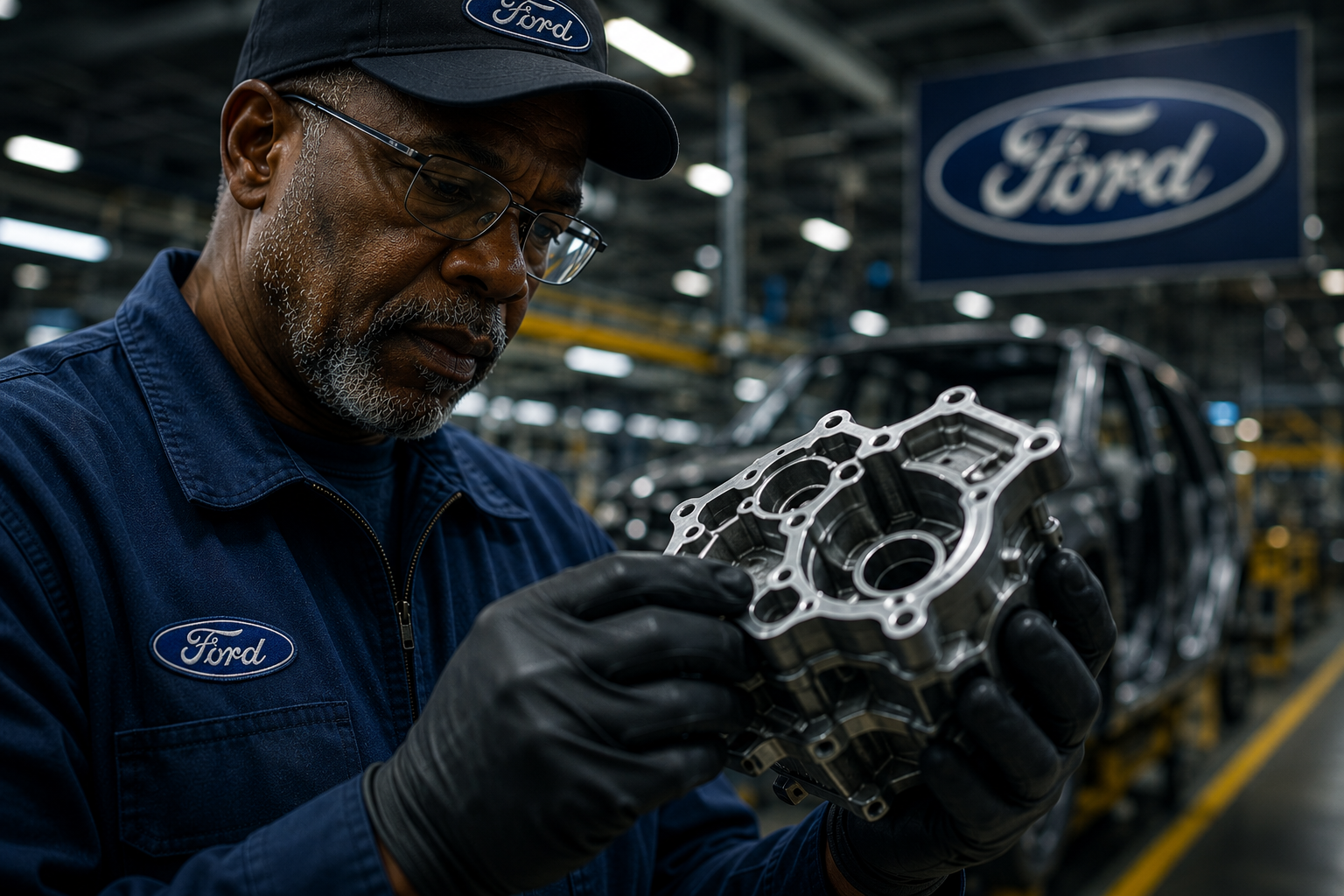
There's a phrase circulating inside Ford's engineering divisions that tells you almost everything about what just happened: "gray beards." That's what Ford employees call the veteran engineers — the ones with decades on the factory floor, the ones who can look at a part and sense, before any sensor does, that something is about to go wrong.
Three years ago, Ford pushed many of those gray beards out the door. This month, the company admitted it has spent the last three years quietly bringing them back.
Ford disclosed to Bloomberg that it has hired 350 veteran engineers since 2023 — many of them former Ford employees, others recruited from suppliers — specifically to fix quality problems that the company's AI-driven inspection and design systems had failed to catch. The cost of those failures, according to Ford's own account, ran into the billions of dollars.
It is, in plain terms, one of the most candid admissions any major company has made about the limits of artificial intelligence in a domain where the stakes are physical, not digital.
How Ford Got Here
The backstory matters, because this wasn't a single bad decision. It was years of a confident, very public strategic bet.
In the early 2020s, as Tesla and Chinese EV makers pressured legacy automakers to modernise faster and cheaper, Ford — like much of Detroit — leaned hard into software, digital twins, and generative AI as the path forward. The pitch was seductive: faster development cycles, fewer physical prototypes, lower costs. Thousands of veteran engineers were moved out through early retirement packages and layoffs, replaced by software developers, simulation algorithms, and automated quality systems.
Ford's COO, Kumar Galhotra, put the company's own logic plainly when describing the reversal: "We had been relying more and more on automated quality systems and not getting the desired results." Charles Poon, Ford's vice president of vehicle hardware engineering, was even more direct: "Mistakenly we thought that by just introducing artificial intelligence and ingesting the design requirements that we had, that [the AI] would be able to" handle quality control the way experienced humans could.
It didn't. The automated systems could check whether a part matched its specification on paper. What they couldn't do was the thing experienced engineers describe almost instinctively — looking at a part, a process, an assembly line, and sensing, through pattern recognition built over decades, that something was going to fail in the real world in a way the spec sheet never anticipated.
What the Returning Engineers Actually Do
The 350 rehired engineers aren't back doing exactly what they did before. Their mandate is specifically built around the gap AI left behind.
According to Ford executives, the returning specialists "hunt for failure points before a part ever reaches the plant floor" — catching problems upstream, before they become expensive, recall-triggering defects downstream. They lead quality reviews across powertrain, manufacturing, and quality-assurance functions, the areas where institutional knowledge proved hardest to replace.
Crucially, they aren't just doing the old job again. Part of their explicit role is training the next generation of engineers and helping reprogram the very AI systems that struggled without them — feeding the kind of nuanced, experience-based judgment back into the automated tools that originally lacked it. Ford has paired this with a dedicated 40-person software quality assurance team and added more than 100,000 AI-powered automated tests designed to catch edge cases that earlier iterations missed.
The framing from Ford is important and worth taking at face value: this isn't a retreat from AI. It's a correction of how AI was deployed — replacing judgment instead of augmenting it.
The Numbers That Make the Story Credible
It would be easy to read this as anecdotal — a few embarrassing headlines about a corporate AI misstep. The data says otherwise.
Ford ranked top among mainstream automotive brands in the latest J.D. Power Initial Quality Survey, the industry's most closely watched quality benchmark, measuring problems reported by owners in the first 90 days of ownership. It is the first time Ford has topped that ranking in 16 years.
CEO Jim Farley has credited the turnaround with delivering what he described as "hundreds and hundreds of millions of dollars" in cost savings through lower warranty and recall expenses. That is not a soft, reputational win. That is a hard financial number tied directly to bringing human judgment back into the production pipeline.
The harder truth sits alongside that win. Ford has issued 51 recalls so far in 2026, covering more than 11 million vehicles — more than double the next-closest automaker, and the most of any US manufacturer this year. Executives have attributed the bulk of those recalls to legacy quality issues from the AI-heavy period the company is now correcting, rather than to the rehiring itself. Whether that explanation fully accounts for the recall numbers or understates the lingering damage is something only time, and future J.D. Power results, will clarify.
The Irony Sitting at the Centre of This Story
There's a detail in this story that deserves its own attention, because it's almost too on the nose to be coincidental.
Jim Farley, Ford's own CEO, has said publicly that AI "is going to replace literally half of all white-collar workers in the US." That prediction now sits awkwardly next to his own company's experience — a case where AI didn't replace skilled workers so much as expose, expensively, exactly how much those workers actually did that nobody had fully accounted for until they were gone.
It's a useful reminder that even executives who are genuine believers in AI's transformative potential can still misjudge, inside their own organisations, which capabilities are safe to automate away and which ones are quietly load-bearing.
Why This Matters Far Beyond Ford
Ford's experience lands at a moment when the conversation about AI and jobs has shifted from theoretical to urgently practical. Just this week, OpenAI, Anthropic, Amazon, and Microsoft backed RAISE US, a $500 million nonprofit led by former US Commerce Secretary Gina Raimondo, specifically created to retrain American workers for an AI-driven economy.
Ford's story complicates the version of that conversation most companies are having. The dominant narrative around AI workforce disruption has largely assumed the challenge is retraining — helping displaced workers acquire new skills for new roles. Ford's experience suggests a different, harder problem sits underneath that one: knowing, before you cut, which workers' judgment and institutional knowledge you genuinely cannot afford to lose. That's a much harder question to answer in advance than "how do we retrain people after the fact" — and Ford appears to have answered it the expensive way, by losing the knowledge first and discovering its value only once it was gone.
It also offers a useful corrective to the broader corporate enthusiasm around AI-driven headcount reduction. Ford isn't a company hostile to AI — it remains deeply committed to AI tooling across its engineering organisation, and the rehired engineers are explicitly tasked with making those AI systems better, not replacing them with human labour wholesale. The lesson Ford's experience offers isn't "don't use AI." It's that AI without the human judgment to validate, correct, and contextualise its output isn't actually a substitute for experienced people — it's a different kind of risk, one that doesn't show up on a balance sheet until something breaks downstream, expensively, at scale.
For any organisation currently weighing AI-driven efficiency against experienced headcount, Ford's billion-dollar correction is the most expensive, most public case study available right now. It's worth reading closely before, not after, making the same bet.
Need help building software?
Talk to the AjiNova team about web applications, mobile platforms, AI integrations, and cloud solutions.