 AjiNova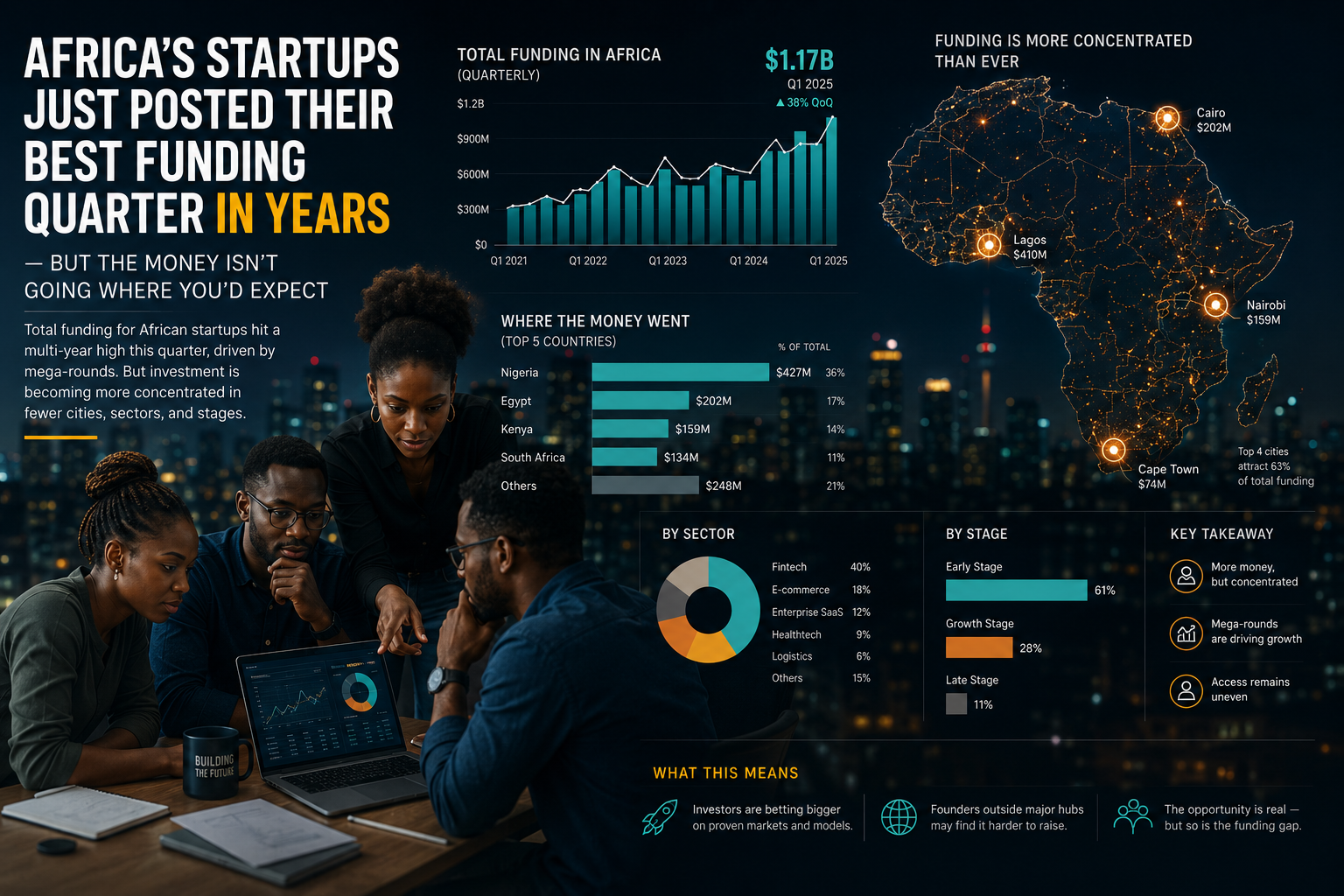
There's a number worth sitting with: $920 million. That's how much African tech startups have raised across 77 equity funding rounds so far in 2026 — and we're not even at the halfway mark of the year. Compare that to the same period in 2025, when the continent had raised $628 million across 103 rounds, and the shift becomes obvious. Fewer deals. Significantly more money.
That single data point captures something important about where African startup funding is heading in 2026, and it isn't simply "more." It's a fundamental change in what kind of capital is flowing, who's getting it, and what that means for the next generation of African tech companies.
The Big Story Isn't Growth — It's Debt
For most of the last decade, the African startup funding conversation was almost entirely about equity: venture capital rounds, valuations, unicorn counts. That conversation is changing in real time.
Debt financing in African startups climbed to a record $1.6 billion in 2025 — a 63% jump — and now represents 41% of total African startup capital, up from just 17% in 2019. That is not a small shift. That is a structural transformation in how African companies fund growth.
The reason is straightforward once you sit with it. Startups with established revenue, physical assets, and predictable cash flow — solar energy companies with pay-as-you-go receivables to securitise, logistics firms with vehicle fleets to collateralise, fintech lenders with loan books to borrow against — increasingly have access to debt on reasonable terms. And debt, unlike equity, doesn't dilute founders.
This is, in its own quiet way, a maturation signal. A continent's startup ecosystem moving from "raise equity because nothing else is available" toward "choose the financing instrument that actually fits the business" is exactly the kind of evolution that distinguishes a developing tech ecosystem from an established one.
The Big Four Get Bigger
Geographically, the concentration that has defined African startup funding for a decade hasn't just persisted into 2026 — it's intensified.
Egypt led the continent in total capital raised in the first quarter of 2026, pulling in somewhere between $154 million and $190 million depending on the data source, anchored by large fintech deals including a $64 million debt round for buy-now-pay-later platform ValU. South Africa followed with roughly $134 to $157 million, driven by the Johannesburg-Cape Town corridor's continued pull on enterprise software, healthtech, and fintech capital from institutional investors comfortable with the regulatory and currency environment there.
Kenya raised an estimated $80 to $100 million in the same period, sustained largely by its energy and logistics deal flow. Nigeria, historically Africa's most active startup market by volume, actually saw total capital decline 28% year-on-year to $78.6 million — even as it recorded the highest number of individual deals on the continent, a sign of vibrant early-stage activity that simply isn't translating into large cheque sizes yet.
Together, these four markets — Egypt, South Africa, Kenya, and Nigeria — accounted for approximately 72% of all capital raised across the continent in 2025. That concentration is both the engine of Africa's tech growth story and its biggest structural vulnerability: investment capacity that hasn't meaningfully broadened beyond four countries in a continent of 54.
Fintech Still Rules, But the Deals Look Different
Fintech remains Africa's largest equity sector by a wide margin. African fintech startups raised $187.1 million across 21 deals in the first quarter of 2026 alone — a nearly 400% jump in deal value compared to the previous quarter, putting the sector on track for its strongest annual total since 2023.
But the texture of those fintech deals has shifted. The headline-grabbing consumer apps chasing growth-at-all-costs that defined fintech funding five years ago have given way to structural plays: payments infrastructure, B2B tooling, embedded finance platforms. Nigerian fintech Moniepoint's extended Series C — over $310 million, processing more than $250 billion in annual transaction value while reaching unicorn-scale profitability — is the template other African fintechs are now being measured against. Profitability, not just growth, is becoming the bar.
What This Means If You're Building in Africa Right Now
For founders, the practical implication is this: the financing conversation has gotten more sophisticated, and that's mostly good news if your business has real revenue and real assets to point to. It's tougher news if you're an early-stage company without either, since seed-stage startups still capture a disproportionately small share of total capital relative to deal volume — contributing 69% of deal count but only 22% of total equity funding in recent data.
The four-country concentration also means founders outside Egypt, South Africa, Kenya, and Nigeria face a structurally harder fundraising environment, regardless of how good their idea is. That's not new information to anyone building in Kigali, Accra, or Kampala — but the data confirms it's not improving as fast as the broader funding numbers might suggest.
The optimistic read is straightforward: African startup funding in 2026 looks less like a market chasing hype and more like one developing real financial infrastructure — debt markets, profitable fintech platforms, structural rather than purely consumer-facing deals. That's a slower, less flashy story than the unicorn headlines of 2021. It might also be a more durable one.
Need help building software?
Talk to the AjiNova team about web applications, mobile platforms, AI integrations, and cloud solutions.