 AjiNova News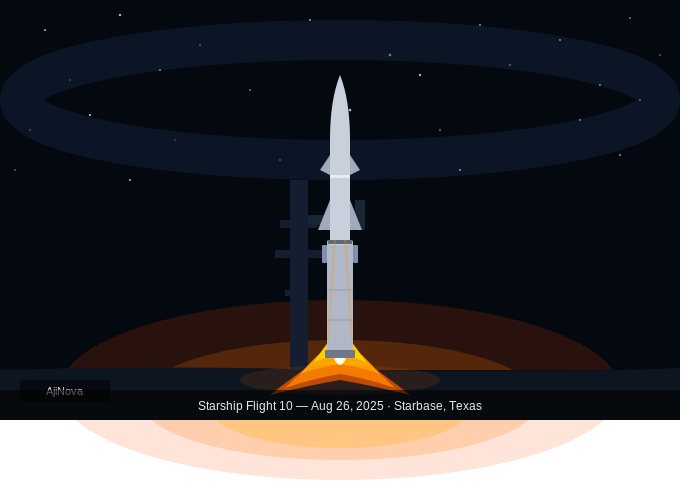
SpaceX's Starship Breaks Its Losing Streak — And This Time, It Made It All the Way Home
There was a moment earlier this year when people started asking, quietly at first and then more loudly, whether SpaceX's Starship program was in real trouble. Three test flights in a row had ended in fiery failure. A fourth vehicle exploded on the ground in June before it even had a chance to fly. The world's most powerful rocket — the one Elon Musk insists will carry humans to Mars — was looking less like humanity's future and more like a very expensive bonfire.
Then came August 26.
At 6:30 p.m. Central Time, Starship's tenth flight test lifted off from Starbase, Texas, taking a significant step forward in developing what SpaceX hopes will become the world's first fully reusable launch vehicle. The 400-foot silver and black rocket roared off the pad with all 33 Raptor engines firing, climbing over the Gulf of Mexico and into the darkening Texas sky. People lined the beaches of South Padre Island to watch.
And for once, it didn't blow up.
While re-entry heating damaged a protective skirt around the engine bay of the upper stage, along with partially melting a control flap near its hinge, the vehicle remained under control throughout and made it all the way to a powered splashdown in the Indian Ocean as planned. The Super Heavy booster, the massive lower stage that gives Starship its lift off the pad, also performed as expected — executing a controlled splashdown in the Gulf of Mexico.
"Splashdown confirmed! Congratulations to the entire SpaceX team on an exciting tenth flight test of Starship!" the company posted on X when it was over.
A win that was badly needed
To understand what this flight meant, you have to understand how rough the year had been. Prior to Flight 10's success on August 26, Starship had suffered explosive failures in three back-to-back test flights in 2025. These setbacks had raised serious questions — not just about SpaceX, but about NASA's plans. The space agency has a $2.9 billion contract with SpaceX for Starship to carry astronauts to the lunar surface, potentially as soon as 2027. Every failure pushed that timeline deeper into uncertainty.
And then in June, as if the year hadn't been difficult enough already, a Starship vehicle preparing for the tenth flight test experienced an anomaly on a test stand at Starbase. The vehicle was in the process of loading cryogenic propellant for a static fire test when a sudden energetic event resulted in the complete loss of the Starship. The investigation eventually traced the explosion to a damaged pressure vessel in the ship's nosecone — a problem that, once identified, led to stricter inspection protocols across the program.
What actually happened up there
Starship completed a full-duration ascent burn, achieved its planned velocity, and successfully put itself on a suborbital trajectory. For the first time, eight Starlink simulator satellites were deployed — the first successful payload demonstration in the program's history.
That last detail matters more than it might seem. SpaceX isn't building Starship just for the spectacle of watching a giant rocket fly. The whole point is to eventually use it to launch satellites, resupply the International Space Station, land on the Moon, and one day reach Mars. Actually deploying a simulated payload — even a fake one — was the program proving it could do something useful, not just survive.
The combination of the Starship and the Super Heavy booster is more than 400 feet tall, made of stainless steel, and is being designed to be fully reusable. During the test flights, engineers intentionally test the limits of the spacecraft, including removing heat tiles in critical areas to gather data.
What comes next
Flight 10 was followed by an 11th test flight — the program's final launch of 2025 — which also succeeded, capping a year that began with genuine doubt about whether Starship could work at all.
The road ahead is still long. Full reusability — the ability to catch both stages back at the launch tower and fly them again — remains the ultimate goal, and SpaceX has only partially achieved it so far. NASA's 2027 lunar landing deadline is ambitious by anyone's measure. And Musk's vision of a city on Mars by the 2030s remains, to put it charitably, optimistic.
But after a year that tested the program's credibility, Flight 10 was something SpaceX — and everyone watching — needed. The rocket made it to space. It deployed its payload. It came back down in one piece.
For a program that had been blowing up its test vehicles all year, that was enough to feel like a genuine turning point.
Information sourced from SpaceX, NASA, NPR, and Spaceflight Now.
Enjoyed this article?
Help AjiNova continue publishing insightful stories about technology, AI, startups, and innovation. Every contribution makes a difference.
Voluntary contribution · Choose your amount
Need help building software?
Talk to the AjiNova team about web applications, mobile platforms, AI integrations, and cloud solutions.